Prefer English?
Prefer English? Switch the website language for a better experience.
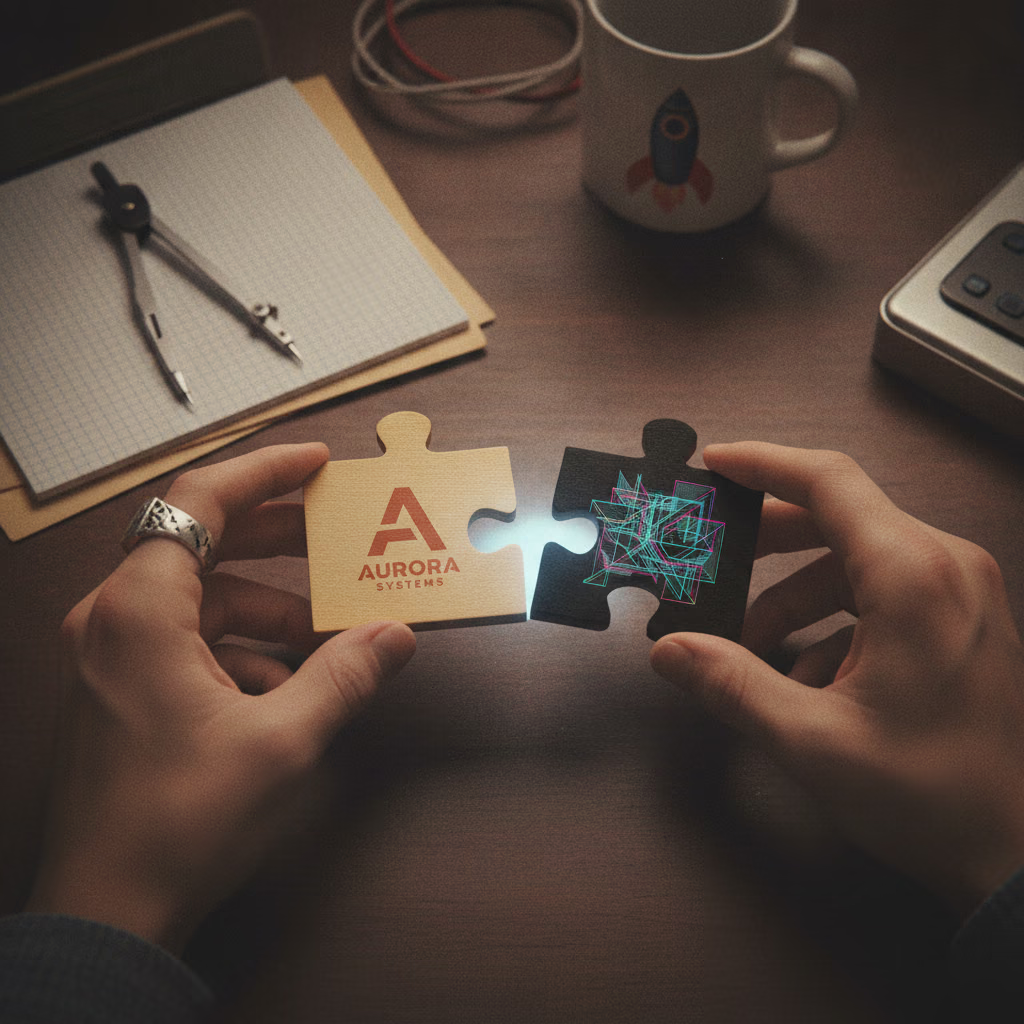


A new feature just dropped in Figma's official changelog, and it's worth pausing on. Since September 17, 2026, Figma node directly connects your Figma Design work to your Figma Weave workflows. In practice: your mockups no longer stay locked inside an isolated file, they become the raw material for your AI generations.
Until now, tapping into Figma Weave's generative AI often meant rebuilding visual elements from scratch, or juggling between two environments with no direct link. Figma node removes that friction. It turns a simple copy-paste into a technical bridge between your design work and content generation at scale.
The concept comes down to four mechanics, designed to stay easy to pick up:
In other words, your brand guidelines remain the foundation. AI doesn't reinvent your visual identity with every generation, it declines it intelligently.
Picture a product banner designed in Figma Design for a campaign. With Figma node, that same banner becomes a living template in Figma Weave: you generate ten localized variations in ten languages, five versions for different ad formats, or an animated video version, without ever touching the original design structure.
This is an interesting shift in logic: you're no longer asking AI to "make it look nice," you're giving it a strict brand framework within which it produces volume. For marketing teams who need to ship fast and at scale while staying consistent, this is exactly the kind of friction we love to see disappear.
| Before Figma node | With Figma node |
|---|---|
| Manually rebuilding visuals for every AI generation | Directly reusing existing Figma Design frames |
| Risk of drifting away from brand guidelines | Font, layout and style stay intact by default |
| Generated assets disconnected from the source file | Automatic sync between Figma and Weave |
| Slow, artisanal production of variations | Generating campaigns and variations at scale |
This announcement fits into a broader momentum. Figma keeps multiplying the bridges between its design tools and its AI building blocks: a conversational agent, generative shaders, custom plugins, and now this direct connection between Design and Weave. If you follow Figma's product news, you've probably already noticed this acceleration, which we broke down in our article on shaders and the Figma agent under the microscope.
The common thread is clear: Figma wants generative AI to stay anchored in an existing design system, rather than operate in a silo. It's a bet that lines up well with how product and marketing teams actually work day to day.
{{webdesign}}
At Mazette.co, Figma has always been part of our daily routine. Every Webflow project we deliver starts with rigorous work in Figma Design, before being translated into the build. So naturally, a feature that directly links this foundational work to a content-generation engine gets our full attention.
Our first observation: Figma node solves a real problem, not a gimmick. Many of the clients we work with need to decline their visual identity across dozens of formats, languages or channels, without losing consistency. Until now, this task stayed time-consuming, often handed off to third-party tools disconnected from the design system. Keeping the style, font and layout intact during generation is exactly the guardrail needed to stop AI from going off in every direction.
Our second observation, a bit more nuanced: automatic sync between Figma and Weave is an excellent idea on paper, but it will demand real organizational discipline in the source files. A poorly named frame, a messy layer structure, and the entire generation chain becomes hard to maintain. In other words, this feature rewards teams that already have a solid design system discipline, and slightly penalizes those working in disorder.
Our verdict: this is good news, no reservations on the principle. Figma keeps proving that generative AI delivers more value when it's built on a defined brand framework, rather than running free. For brands producing a lot of declined visual content, this is a genuine time-saver. And for us, an agency that builds custom Webflow experiences, it's one more confirmation that Figma remains the central tool around which an entire production chain revolves, from the first wireframe all the way to launch.
Code


Over 120 companies have already stepped out of the shadows with us.


Figma Weave is Figma's tool dedicated to generative AI workflows. It lets you create images, videos, sounds and campaign visuals from prompts, organized as reusable workflows. With Figma node, these workflows can now draw directly on your existing Figma designs instead of starting from scratch.
Yes, Figma Weave is available today, along with the Figma node feature announced on September 17, 2026. You can copy a frame from Figma Design and paste it into Figma Weave to create a workflow node immediately, with no complex setup required.
Simply select a frame in Figma Design, copy it, then paste it directly into Figma Weave: it automatically becomes a usable node in your workflow. You then choose which text or image layers remain editable, while keeping the original font, layout and style intact.
Impactful titles, polished meta descriptions, sitemaps, Schema.org, Hn structure, and audits: these are the SEO foundations that make your content readable by both Google AND generative AI. We cover both simultaneously.


With over 180 clients, our agency is one of the few in France to hold the Webflow Premium Partner label, supporting you in every area, including custom web design, sophisticated automation, conversion optimization, and SEO and GEO visibility.


We create bespoke web designs focused on performance, user journeys, and conversion. Join over 180 clients who have trusted us to elevate their brand.