Prefer English?
Prefer English? Switch the website language for a better experience.
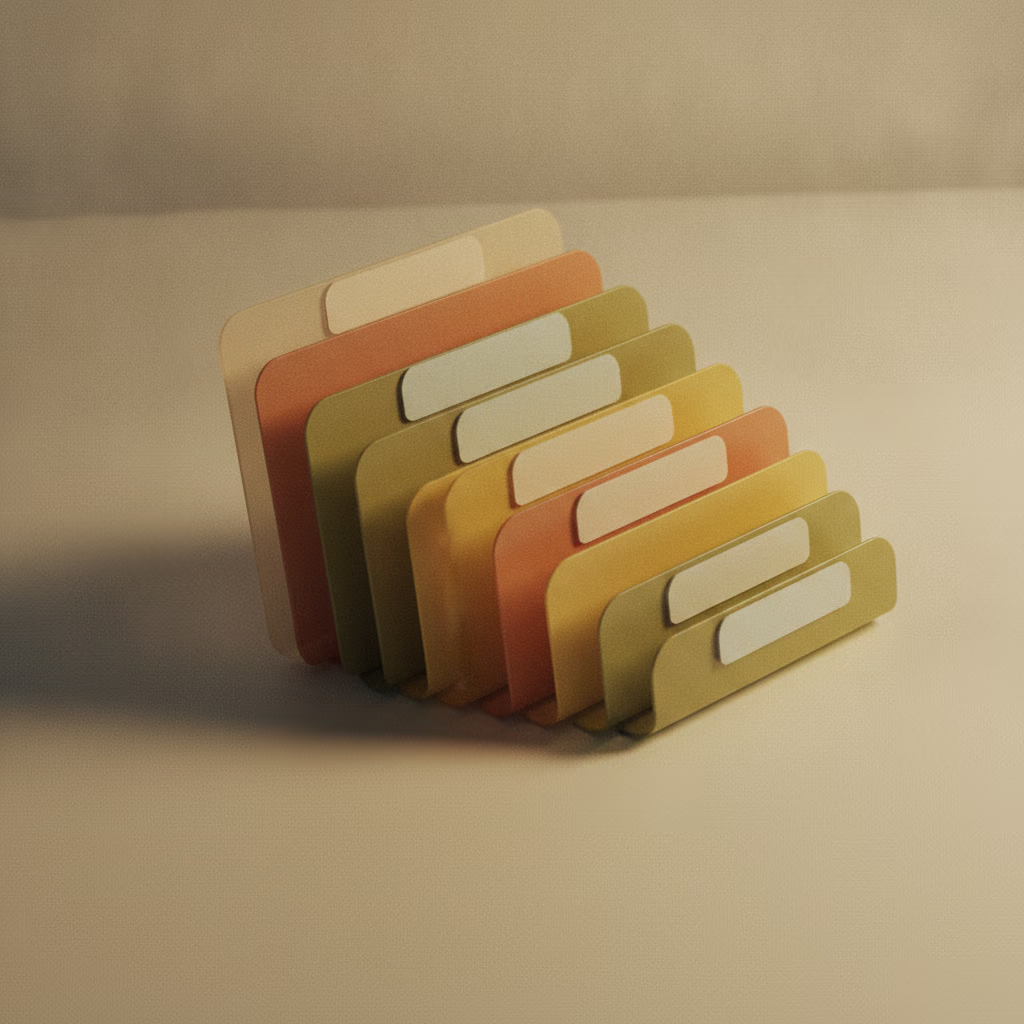


Until now, structuring a Figma account often meant stacking dozens of "Projects" flat, with no hierarchy possible. A growing team, a client juggling multiple brands, an agency managing fifteen accounts at once: past a certain volume, finding the right file turned into a scavenger hunt.
Figma is fixing this with nested folders. In practice, Projects become regular folders, which you can now stack inside one another, up to 10 levels deep, and color-code for instant visual cues.
The rollout is happening gradually over the coming weeks, across all plans, from Starter to Enterprise.
On paper, this looks like a simple organizational feature. In practice, it is a direct answer to a problem every agency or product team knows well: a tool's structure needs to keep up with the growth of the work, not hold it back.
Previously, the only way to fake a hierarchy was to prefix Project names with homemade conventions ("01_Client_Brand_Phase2"), or multiply Teams to make up for the lack of nesting. It worked, but it demanded iron discipline and quickly fell apart the moment new team members joined.
| Before (Projects) | After (Nested Folders) |
|---|---|
| Flat structure, a single level per team | Up to 10 levels of nesting |
| No native visual reference | Color-coded folders for instant hierarchy at a glance |
| Sharing configured file by file or project by project | Automatic inheritance of access from the parent folder |
| Homemade naming conventions to fake a hierarchy | Native structure that reflects how the work is actually organized |
{{webdesign}}
At Mazette.co, we juggle multiple brands, multiple clients, and sometimes several project phases within a single account on a daily basis. Needless to say, we had been waiting for this feature for quite a while.
What we particularly appreciate is the permission inheritance. On a client project with sub-brands or regional variations, being able to set access once at the parent folder level, then fine-tune it for a specific sensitive subfolder (a phase that is still confidential, for example), is exactly the level of granularity that was missing. Before, we had to piece things together with file-by-file sharing, which always ended up leaving gaps.
Folder color-coding might seem purely cosmetic at first glance. But on accounts juggling fifteen active projects at once, that kind of visual cue saves precious seconds every time you open Figma, and seconds multiplied by the number of designers on an account eventually add up.
One caveat though: the 10-level nesting limit, generous as it sounds, can also become a trap. Nothing stops a poorly disciplined team from building an endless tree structure, just as unreadable as a 2000s-era Windows file system. The feature gives you the tools to organize well, but it does not guarantee you will use them wisely. As always with Figma, governance remains a human matter before it is a tooling one.
Our recommendation for teams managing multiple accounts or brands: use this change as an opportunity to rethink your folder structure now, rather than simply recreating your old, poorly stacked Projects. This is the perfect moment to finally clean house.
If you work with Figma daily on web projects, this update fits into a broader trend: a tool maturing toward large-scale team workflows. Worth following alongside the developments around Figma Motion and the AI agents announced at Config 2026, which are also set to reshape how we collaborate within the tool.
Code


Over 120 companies have already stepped out of the shadows with us.


No manual migration is needed. Figma automatically converts all your existing Projects into folders as soon as the feature rolls out to your account. All files, permissions, and locations stay exactly the same, only the name and display structure change.
Yes, Figma has announced a gradual rollout across all plans, including free accounts. The timing of availability depends on your organization, with the rollout spread over several weeks starting from the announcement.
Projects were flat, limited to a single level per team. Folders can now nest up to 10 levels deep, can be color-coded for visual reference, and inherit access permissions from the parent folder while still allowing targeted exceptions.
Impactful titles, polished meta descriptions, sitemaps, Schema.org, Hn structure, and audits: these are the SEO foundations that make your content readable by both Google AND generative AI. We cover both simultaneously.


With over 180 clients, our agency is one of the few in France to hold the Webflow Premium Partner label, supporting you in every area, including custom web design, sophisticated automation, conversion optimization, and SEO and GEO visibility.


We create bespoke web designs focused on performance, user journeys, and conversion. Join over 180 clients who have trusted us to elevate their brand.